Why the most expensive shot in cinema history now costs the same as a shampoo product shot, and what that means for the future of marketing and everyone making content.

Remember when this was impossible?
There is a shot in Transformers: Age of Extinction where a spacecraft tears through the skyline of Hong Kong. Buildings crumble. Debris scatters into photorealistic dust clouds. The camera swoops through it all in a single, impossibly fluid take. That sequence reportedly cost north of $20 million to produce. Hundreds of artists. Months of render time. A pipeline so complex it required its own project management infrastructure just to track the dependencies.
The shot in question, from Transformers: Age of Extinction (2014).
For a generation of filmmakers, VFX supervisors, and commercial producers, shots like that were sacred ground. They represented the absolute ceiling of what was possible. You looked at that work and you felt something. Awe, aspiration, maybe a quiet resignation that your budgets would never, ever get you there.
That feeling is about to become a liability.
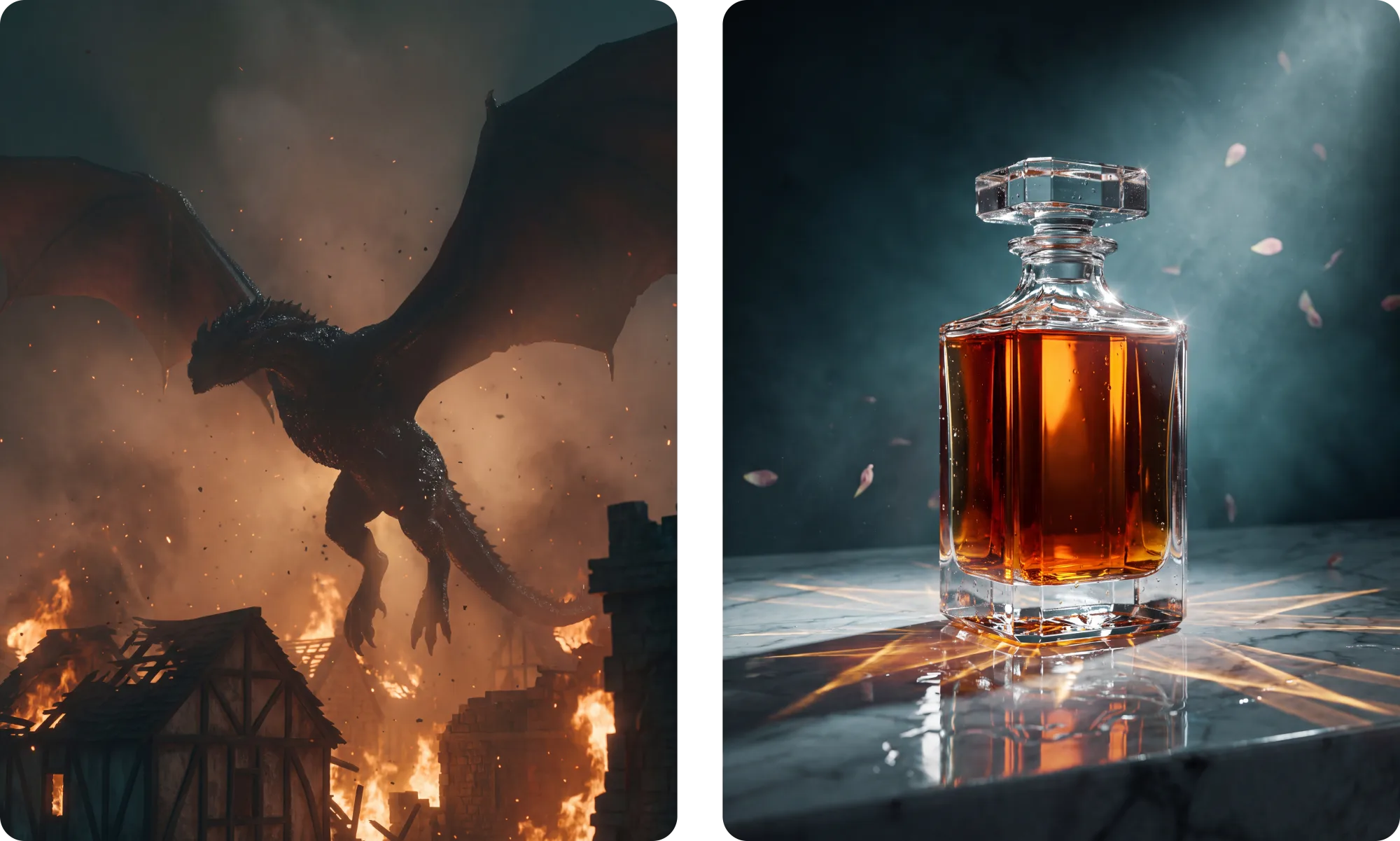
Same tool. Same process. Same cost. Different context, identical execution.
The flattening cost curve
Here's something nobody in the creative industry wants to say out loud. In our AI-first production pipeline, the computational cost of generating a dragon destroying a city is functionally identical to the cost of generating a perfume bottle on a marble countertop.
Read that again, because it matters.
The dragon does not cost more. The explosions do not cost more. The particle simulations, the volumetric lighting, the photorealistic skin rendering, none of it commands a premium anymore. The complexity of what you depict has been decoupled from the cost of depicting it.
This is the entire economic foundation of visual content production inverting itself. For decades, the unspoken contract was simple. Epic-looking content costs epic money. If you wanted something that looked like a Marvel film, you needed a Marvel budget (and time), or at least a meaningful fraction of one. The visual ambition of your content was fundamentally gated by your resources.
That horse has bolted and the gate's gone.
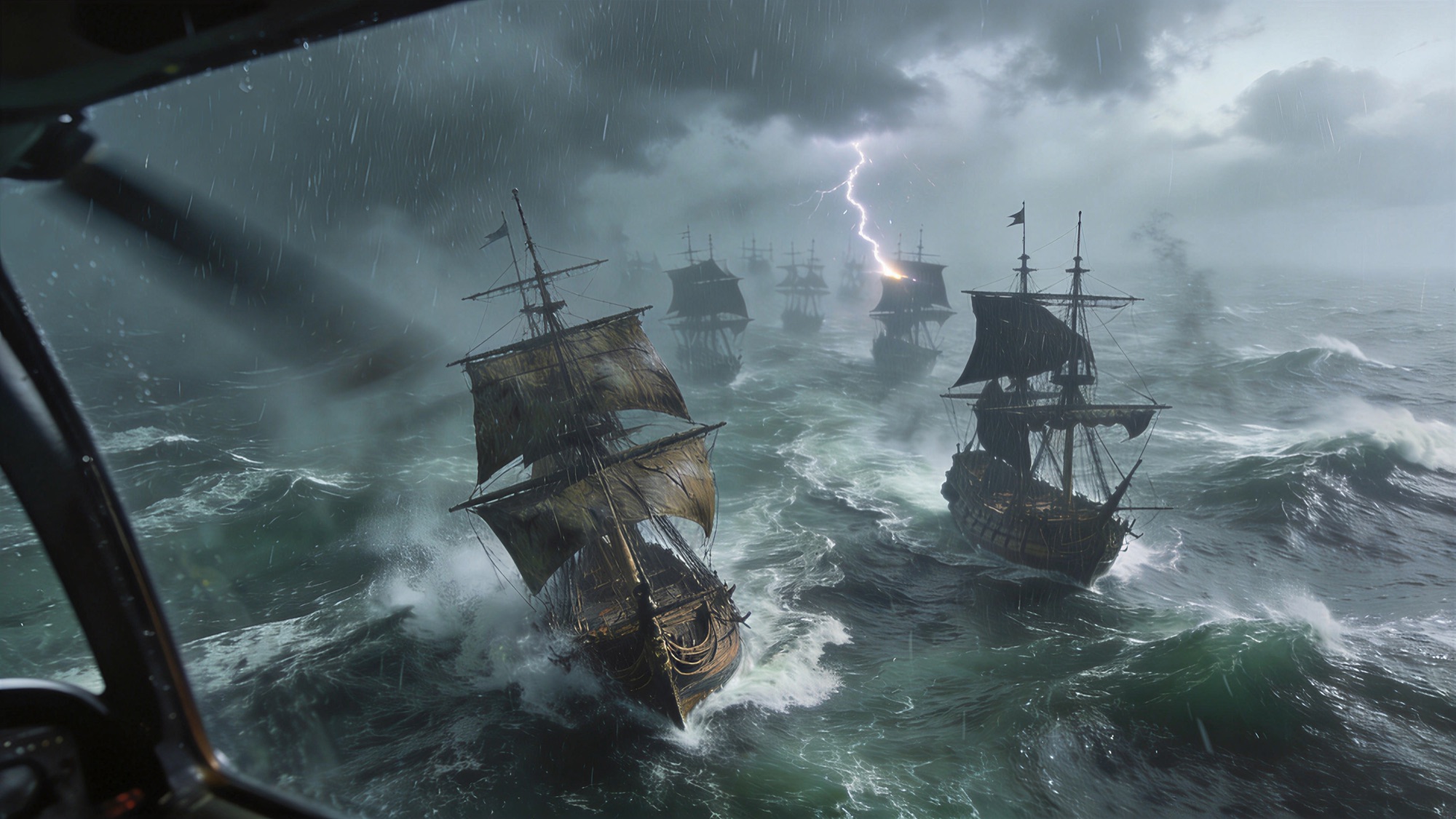
This image exists because someone typed a sentence. Not because someone spent six months in compositing.
The hard part isn't the technology. It's your brain.
If you have spent any time in production (as a creative director, a brand manager, accounts manager, DoP, VFX artist, or CGI artist), you've been trained, over years and thousands of projects, to associate visual complexity with value. It is not a conscious calculation. It's instinct. You see a shot with intricate lighting, complex camera movement, layered compositing, and your brain assigns it worth. Important. Expensive. Premium.
You see a clean product shot on white, and your brain files it differently. Simpler. Cheaper. Commodity.
That instinct served you well for thirty years. It is now actively misleading you.
The creative brain has been trained to equate visual complexity with production value. In an AI-first world, that equation no longer holds, and unlearning it is the real creative challenge.
This is not about technology adoption. Every studio will adopt the tools, that part is inevitable and, frankly, unremarkable. The genuine challenge is psychological. It is the rewiring of a value system that has been reinforced by every brief, every budget conversation, every award submission, and every client presentation for decades.

An astronaut above Earth. A raindrop on a leaf. A moisturiser on stone. Your brain wants to rank these by complexity. The production pipeline does not.
If everything is epic, nothing is
There is a version of this conversation that descends into nihilism. If a dragon battle costs the same as a product render, does anything have value anymore? If anyone can produce blockbuster-grade visuals, what is the point of expertise?
This is the wrong question, but it is the one most people ask first, and it is worth taking seriously.
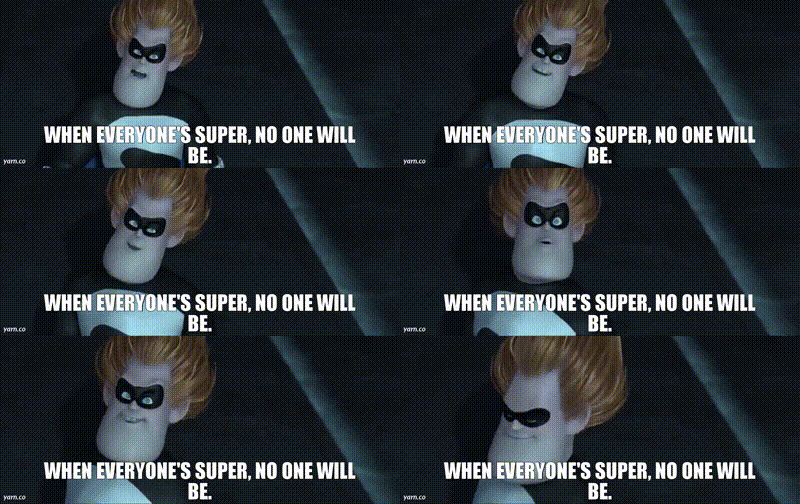
The Incredibles said it best. "When everyone is super, no one will be." The democratisation of visual spectacle does not eliminate value. It relocates it. The question is where.
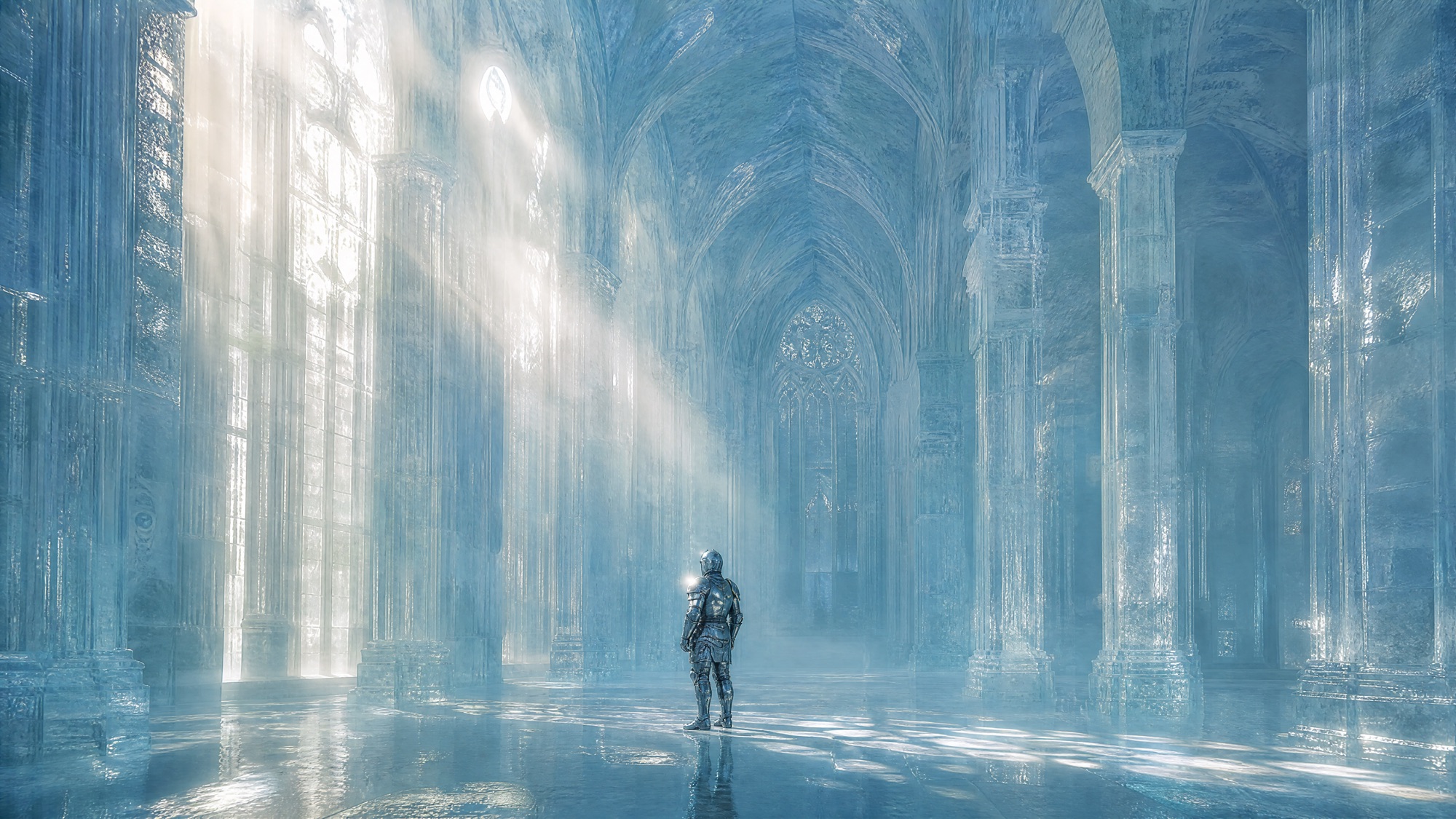
Stunning. But what is it for? Without narrative intent, visual spectacle is wallpaper.
The new value hierarchy
Narrative intelligence. The ability to connect visual content to a strategic outcome. Not "make it look amazing" but "make it communicate something specific to someone specific at a moment that matters." A dragon destroying a city is meaningless unless it is serving a story. A perfume bottle on marble is meaningless unless it is saying something about the person who picks it up.
Consistency at scale. Anyone can generate one beautiful image. The challenge is generating five hundred that feel like they belong to the same brand, the same world, the same standard of quality, without burning through endless iterations to get there. This is where production intelligence, not just production capability, becomes the differentiator.
Creative governance. The freedom to create anything brings with it the obligation to create the right thing. Quality control in an AI-augmented pipeline is not about checking pixels. It is about maintaining the editorial judgement, the brand coherence, and the creative standards that separate purposeful content from noise.
Provenance and trust. When content can be generated at near-zero marginal cost, the question of where it came from and how it was made starts to matter enormously. Brands need to know their content is defensible, trained on legitimate data, produced through auditable processes, and aligned with their values. This is not a compliance checkbox. It is an emerging competitive advantage.
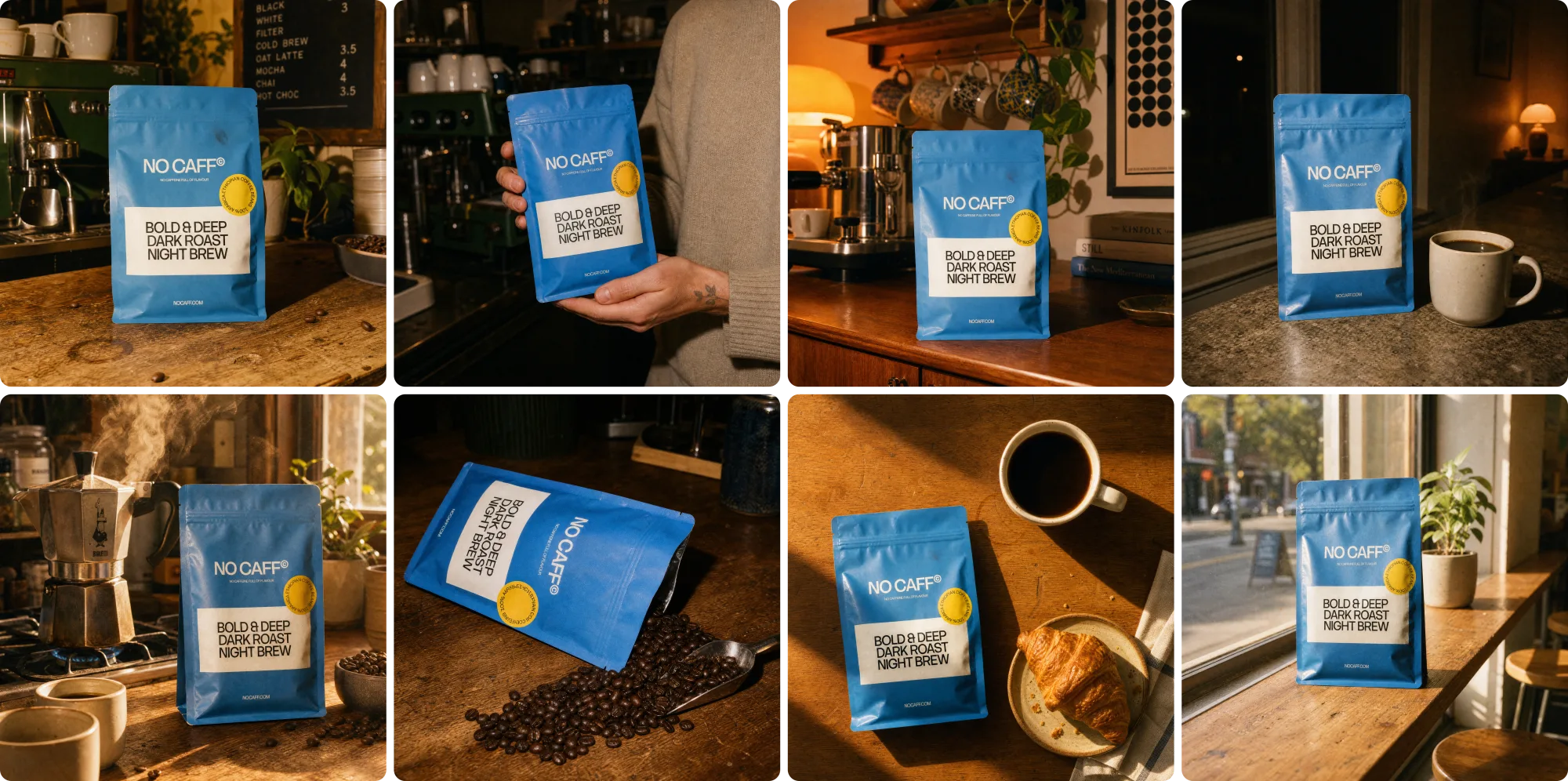
8 scenes. 8 contexts. One unmistakable brand. This is what production intelligence looks like at scale.
This is not an obituary for production
Let us be clear about something. None of this means traditional production is dead. That is a lazy take, and it misreads what is actually happening.
Physical production (real cameras, real sets, real talent) carries an authenticity and a tactile quality that generated content cannot replicate. The smell of a set. The energy of a crew. The happy accidents that happen when light bounces off a surface nobody expected. These things have value, and they will continue to have value.
What changes is the mix. The ratio. The default.
In a hybrid production model, physical shoots become more intentional, reserved for moments where the real, tangible quality of captured footage genuinely serves the narrative. Everything else can be generated, iterated, and deployed with speed and consistency that physical production simply cannot match. The skill is knowing which is which.

The future is not AI versus physical. It is knowing where one ends and the other begins, and making sure the audience never has to ask.
Casting off
If you are a creative professional reading this, there is a good chance you felt a twinge of resistance somewhere in the last few paragraphs. That is normal. It is also the point.
The instinct to protect the value systems you have built your career on is entirely human. The techniques you mastered, the budgets you fought for, the impossible shots you pulled off at 2am on a Friday, those accomplishments are real, and they matter. Nobody is suggesting otherwise.
But holding onto a pricing model, a production hierarchy, or a creative value system that was built for a world of scarcity, in a world that has just moved to abundance, is not loyalty to craft. It is a refusal to see what is in front of you.
The question is not whether AI can make what you make. It already can. The question is whether you can do what AI can't, which is to decide what's worth making, and why.
The creative professionals who will thrive aren't the ones who resist the tools or mourn the old economics. They are the ones who recognise that the levelling of execution is, paradoxically, the greatest liberation creative work has ever experienced.
When you no longer have to spend 80% of your energy and budget on the mechanics of making something look good, you can spend it on making it mean something.

The new epic is not louder. It is smarter.
More from the blog
 Company News
Tungsten Welcomes James Pierechod to the Board
Tungsten Media welcomes James Pierechod as a new shareholder and Non-Executive Director to drive innovation and growth in multi-disciplinary creative production.
 Strategy
Why Does My Brand Need Video Content?
Video content is essential for branding in 2023. Discover how high-quality video can increase credibility, enhance trust, and open up new marketing opportunities. Learn how Tungsten can help you create dynamic and innovative video content that will stand out from the crowd.
 Case Study
Bringing EvenGreener's Sustainability Mission to Life Through Impactful Storytelling
Excited to share our upcoming ads with eco-brand EvenGreener, using funny, relatable stories to inspire audiences to build a greener future.